Show PDB file:   
         Plain Text   HTML   (compressed file size)
QuickSearch:   
by PDB,NDB,UniProt,PROSITE Code or Search Term(s)  
(-)Theoretical Model
collapse expand < >
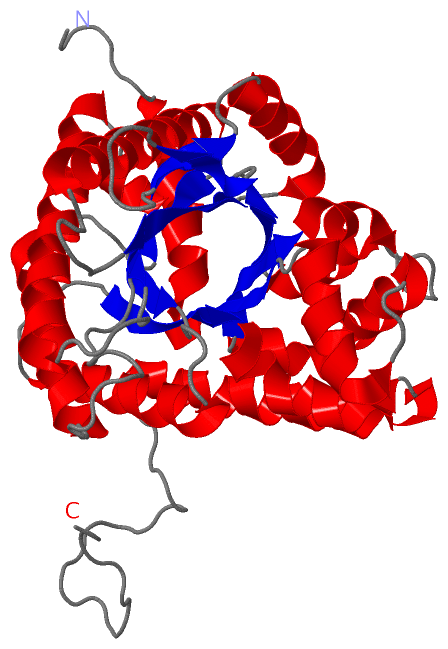
Image Theoretical Model
Theoretical Model  (Jmol Viewer)

(-) Description

Title :  FRUCTOSE-BISPHOSPHATE ALDOLASE B
 
Authors :  K. Beesetti
Date :  25 Oct 02  (Deposition) - 13 Nov 02  (Release) - 13 Nov 02  (Revision)
Method :  THEORETICAL MODEL
Resolution :  NOT APPLICABLE
Chains :  Theor. Model :  A
Keywords :  Lyase, Schiff Base, Glycolysis, Multigene Family (Keyword Search: [Gene Ontology, PubMed, Web (Google))
 
Reference :  K. Beesetti
Theoretical Model Of Fructose-Bisphosphate Aldolase B
To Be Published
PubMed: search
(for further references see the PDB file header)

(-) Compounds

Molecule 1 - FRUCTOSE-BISPHOSPHATE ALDOLASE B
    ChainsA
    EC Number4.1.2.13
    Organism CommonRAT
    Organism ScientificRATTUS NORVEGICUS

 Structural Features

(-) Chains, Units

  
Theoretical Model 

Summary Information (see also Sequences/Alignments below)

(-) Ligands, Modified Residues, Ions  (0, 0)

(no "Ligand,Modified Residues,Ions" information available for 1N30)

(-) Sites  (0, 0)

(no "Site" information available for 1N30)

(-) SS Bonds  (0, 0)

(no "SS Bond" information available for 1N30)

(-) Cis Peptide Bonds  (1, 1)

Theoretical Model
No.Residues
1Cys A:157 -Pro A:158

 Sequence-Structure Mapping

(-) SAPs(SNPs)/Variants  (0, 0)

(no "SAP(SNP)/Variant" information available for 1N30)

(-) PROSITE Motifs  (1, 1)

Theoretical Model (1, 1)
 PROSITEUniProtKBPDB
No.IDACDescriptionIDLocationCountLocation
1ALDOLASE_CLASS_IPS00158 Fructose-bisphosphate aldolase class-I active site.ALDOB_RAT222-232  1A:221-231

(-) Exons   (0, 0)

(no "Exon" information available for 1N30)

(-) Sequences/Alignments

Theoretical Model
   Reformat: Number of residues per line =  ('0' or empty: single-line sequence representation)
  Number of residues per labelling interval =   
  UniProt sequence: complete  aligned part    
   Show mapping: SCOP domains CATH domains Pfam domains Secondary structure (by author)
SAPs(SNPs) PROSITE motifs Exons
(details for a mapped element are shown in a popup box when the mouse pointer rests over it)
Chain A from PDB  Type:PROTEIN  Length:363
 aligned with ALDOB_RAT | P00884 from UniProtKB/Swiss-Prot  Length:364

    Alignment length:363
                                    11        21        31        41        51        61        71        81        91       101       111       121       131       141       151       161       171       181       191       201       211       221       231       241       251       261       271       281       291       301       311       321       331       341       351       361   
            ALDOB_RAT     2 AHRFPALTSEQKKELSEIAQRIVANGKGILAADESVGTMGNRLQRIKVENTEENRRQFRELLFSVDNSISQSIGGVILFHETLYQKDSQGKLFRNILKEKGIVVGIKLDQGGAPLAGTNKETTIQGLDGLSERCAQYKKDGVDFGKWRAVLRISDQCPSSLAIQENANALARYASICQQNGLVPIVEPEVLPDGDHDLEHCQYVSEKVLAAVYKALNDHHVYLEGTLLKPNMLTAGHACTKKYTPEQVAMATVTALHRTVPAAVPSICFLSGGMSEEDATLNLNAIYRCPLPRPWKLSFSYGRALQASALAAWGGKAANKKATQEAFMKRAVANCQAAQGQYVHTGSSGAASTQSLFTASYTY 364
               SCOP domains --------------------------------------------------------------------------------------------------------------------------------------------------------------------------------------------------------------------------------------------------------------------------------------------------------------------------------------------------------------------------- SCOP domains
               CATH domains --------------------------------------------------------------------------------------------------------------------------------------------------------------------------------------------------------------------------------------------------------------------------------------------------------------------------------------------------------------------------- CATH domains
               Pfam domains --------------------------------------------------------------------------------------------------------------------------------------------------------------------------------------------------------------------------------------------------------------------------------------------------------------------------------------------------------------------------- Pfam domains
         Sec.struct. author .......hhhhhhhhhhhhhhhhhhhheeeee..hhhhhhhhhhhhh...hhhhhhhhhhhhhh.hhhhhh.eeeeeehhhhhhh......hhhhhhhhhh.eeeee...eeee.......eeee...hhhhhhhhhhhhh..eeeeeeee.......hhhhhhhhhhhhhhhhhhhhhh..eeeeeeee......hhhhhhhhhhhhhhhhhhhhhhh..hhhhhee...............hhhhhhhhhhhhhhhhh.....eeee.....hhhhhhhhhhhhhhh......eeeeeehhhhhhhhhhhhh.hhhhhhhhhhhhhhhhhhhhhhhhh....................... Sec.struct. author
                 SAPs(SNPs) --------------------------------------------------------------------------------------------------------------------------------------------------------------------------------------------------------------------------------------------------------------------------------------------------------------------------------------------------------------------------- SAPs(SNPs)
                    PROSITE ----------------------------------------------------------------------------------------------------------------------------------------------------------------------------------------------------------------------------ALDOLASE_CL------------------------------------------------------------------------------------------------------------------------------------ PROSITE
                 Transcript --------------------------------------------------------------------------------------------------------------------------------------------------------------------------------------------------------------------------------------------------------------------------------------------------------------------------------------------------------------------------- Transcript
                 1n30 A   1 AHRFPALTSEQKKELSEIAQRIVANGKGILAADESVGTMGNRLQRIKVENTEENRRQFRELLFSVDNSISQSIGGVILFHETLYQKDSQGKLFRNILKEKGIVVGIKLDQGGAPLAGTNKETTIQGLDGLSERCAQYKKDGVDFGKWRAVLRISDQCPSSLAIQENANALARYASICQQNGLVPIVEPEVLPDGDHDLEHCQYVSEKVLAAVYKALNDHHVYLEGTLLKPNMLTAGHACTKKYTPEQVAMATVTALHRTVPAAVPSICFLSGGMSEEDATLNLNAIYRCPLPRPWKLSFSYGRALQASALAAWGGKAANKKATQEAFMKRAVANCQAAQGQYVHTGSSGAASTQSLFTASYTY 363
                                    10        20        30        40        50        60        70        80        90       100       110       120       130       140       150       160       170       180       190       200       210       220       230       240       250       260       270       280       290       300       310       320       330       340       350       360   

   Legend:   → Mismatch (orange background)
  - → Gap (green background, '-', border residues have a numbering label)
    → Modified Residue (blue background, lower-case, 'x' indicates undefined single-letter code, labelled with number + name)
  x → Chemical Group (purple background, 'x', labelled with number + name, e.g. ACE or NH2)
  extra numbering lines below/above indicate numbering irregularities and modified residue names etc., number ends below/above '|'

 Classification and Annotation

(-) SCOP Domains  (0, 0)

(no "SCOP Domain" information available for 1N30)

(-) CATH Domains  (0, 0)

(no "CATH Domain" information available for 1N30)

(-) Pfam Domains  (0, 0)

(no "Pfam Domain" information available for 1N30)

(-) Gene Ontology  (31, 31)

Theoretical Model(hide GO term definitions)
Chain A   (ALDOB_RAT | P00884)
molecular function
    GO:0003824    catalytic activity    Catalysis of a biochemical reaction at physiological temperatures. In biologically catalyzed reactions, the reactants are known as substrates, and the catalysts are naturally occurring macromolecular substances known as enzymes. Enzymes possess specific binding sites for substrates, and are usually composed wholly or largely of protein, but RNA that has catalytic activity (ribozyme) is often also regarded as enzymatic.
    GO:0004332    fructose-bisphosphate aldolase activity    Catalysis of the reaction: D-fructose 1,6-bisphosphate = glycerone phosphate + D-glyceraldehyde-3-phosphate.
    GO:0016829    lyase activity    Catalysis of the cleavage of C-C, C-O, C-N and other bonds by other means than by hydrolysis or oxidation, or conversely adding a group to a double bond. They differ from other enzymes in that two substrates are involved in one reaction direction, but only one in the other direction. When acting on the single substrate, a molecule is eliminated and this generates either a new double bond or a new ring.
    GO:0031210    phosphatidylcholine binding    Interacting selectively and non-covalently with phosphatidylcholine, a class of glycophospholipids in which a phosphatidyl group is esterified to the hydroxyl group of choline.
biological process
    GO:0031668    cellular response to extracellular stimulus    Any process that results in a change in state or activity of a cell (in terms of movement, secretion, enzyme production, gene expression, etc.) as a result of an extracellular stimulus.
    GO:0032869    cellular response to insulin stimulus    Any process that results in a change in state or activity of a cell (in terms of movement, secretion, enzyme production, gene expression, etc.) as a result of an insulin stimulus. Insulin is a polypeptide hormone produced by the islets of Langerhans of the pancreas in mammals, and by the homologous organs of other organisms.
    GO:0006096    glycolytic process    The chemical reactions and pathways resulting in the breakdown of a carbohydrate into pyruvate, with the concomitant production of a small amount of ATP and the reduction of NAD(P) to NAD(P)H. Glycolysis begins with the metabolism of a carbohydrate to generate products that can enter the pathway and ends with the production of pyruvate. Pyruvate may be converted to acetyl-coenzyme A, ethanol, lactate, or other small molecules.
    GO:0001889    liver development    The process whose specific outcome is the progression of the liver over time, from its formation to the mature structure. The liver is an exocrine gland which secretes bile and functions in metabolism of protein and carbohydrate and fat, synthesizes substances involved in the clotting of the blood, synthesizes vitamin A, detoxifies poisonous substances, stores glycogen, and breaks down worn-out erythrocytes.
    GO:0043200    response to amino acid    Any process that results in a change in state or activity of a cell or an organism (in terms of movement, secretion, enzyme production, gene expression, etc.) as a result of an amino acid stimulus. An amino acid is a carboxylic acids containing one or more amino groups.
    GO:0051591    response to cAMP    Any process that results in a change in state or activity of a cell or an organism (in terms of movement, secretion, enzyme production, gene expression, etc.) as a result of a cAMP (cyclic AMP, adenosine 3',5'-cyclophosphate) stimulus.
    GO:0009743    response to carbohydrate    Any process that results in a change in state or activity of a cell or an organism (in terms of movement, secretion, enzyme production, gene expression, etc.) as a result of a carbohydrate stimulus.
    GO:0046688    response to copper ion    Any process that results in a change in state or activity of a cell or an organism (in terms of movement, secretion, enzyme production, gene expression, etc.) as a result of a copper ion stimulus.
    GO:0042493    response to drug    Any process that results in a change in state or activity of a cell or an organism (in terms of movement, secretion, enzyme production, gene expression, etc.) as a result of a drug stimulus. A drug is a substance used in the diagnosis, treatment or prevention of a disease.
    GO:0009750    response to fructose    Any process that results in a change in state or activity of a cell or an organism (in terms of movement, secretion, enzyme production, gene expression, etc.) as a result of a fructose stimulus.
    GO:0051384    response to glucocorticoid    Any process that results in a change in state or activity of a cell or an organism (in terms of movement, secretion, enzyme production, gene expression, etc.) as a result of a glucocorticoid stimulus. Glucocorticoids are hormonal C21 corticosteroids synthesized from cholesterol with the ability to bind with the cortisol receptor and trigger similar effects. Glucocorticoids act primarily on carbohydrate and protein metabolism, and have anti-inflammatory effects.
    GO:0070741    response to interleukin-6    Any process that results in a change in state or activity of a cell or an organism (in terms of movement, secretion, enzyme production, gene expression, etc.) as a result of an interleukin-6 stimulus.
    GO:0014070    response to organic cyclic compound    Any process that results in a change in state or activity of a cell or an organism (in terms of movement, secretion, enzyme production, gene expression, etc.) as a result of an organic cyclic compound stimulus.
    GO:0043434    response to peptide hormone    Any process that results in a change in state or activity of a cell or an organism (in terms of movement, secretion, enzyme production, gene expression, etc.) as a result of a peptide hormone stimulus. A peptide hormone is any of a class of peptides that are secreted into the blood stream and have endocrine functions in living animals.
    GO:0042594    response to starvation    Any process that results in a change in state or activity of a cell or an organism (in terms of movement, secretion, enzyme production, gene expression, etc.) as a result of a starvation stimulus, deprivation of nourishment.
    GO:0010043    response to zinc ion    Any process that results in a change in state or activity of a cell or an organism (in terms of movement, secretion, enzyme production, gene expression, etc.) as a result of a zinc ion stimulus.
cellular component
    GO:0005737    cytoplasm    All of the contents of a cell excluding the plasma membrane and nucleus, but including other subcellular structures.
    GO:0005856    cytoskeleton    Any of the various filamentous elements that form the internal framework of cells, and typically remain after treatment of the cells with mild detergent to remove membrane constituents and soluble components of the cytoplasm. The term embraces intermediate filaments, microfilaments, microtubules, the microtrabecular lattice, and other structures characterized by a polymeric filamentous nature and long-range order within the cell. The various elements of the cytoskeleton not only serve in the maintenance of cellular shape but also have roles in other cellular functions, including cellular movement, cell division, endocytosis, and movement of organelles.
    GO:0005829    cytosol    The part of the cytoplasm that does not contain organelles but which does contain other particulate matter, such as protein complexes.
    GO:0043231    intracellular membrane-bounded organelle    Organized structure of distinctive morphology and function, bounded by a single or double lipid bilayer membrane and occurring within the cell. Includes the nucleus, mitochondria, plastids, vacuoles, and vesicles. Excludes the plasma membrane.
    GO:0005764    lysosome    A small lytic vacuole that has cell cycle-independent morphology and is found in most animal cells and that contains a variety of hydrolases, most of which have their maximal activities in the pH range 5-6. The contained enzymes display latency if properly isolated. About 40 different lysosomal hydrolases are known and lysosomes have a great variety of morphologies and functions.
    GO:0005815    microtubule organizing center    An intracellular structure that can catalyze gamma-tubulin-dependent microtubule nucleation and that can anchor microtubules by interacting with their minus ends, plus ends or sides.
    GO:0005634    nucleus    A membrane-bounded organelle of eukaryotic cells in which chromosomes are housed and replicated. In most cells, the nucleus contains all of the cell's chromosomes except the organellar chromosomes, and is the site of RNA synthesis and processing. In some species, or in specialized cell types, RNA metabolism or DNA replication may be absent.
    GO:0048471    perinuclear region of cytoplasm    Cytoplasm situated near, or occurring around, the nucleus.
    GO:0005886    plasma membrane    The membrane surrounding a cell that separates the cell from its external environment. It consists of a phospholipid bilayer and associated proteins.
    GO:0030867    rough endoplasmic reticulum membrane    The lipid bilayer surrounding the rough endoplasmic reticulum.
    GO:0030868    smooth endoplasmic reticulum membrane    The lipid bilayer surrounding the smooth endoplasmic reticulum.

 Visualization

(-) Interactive Views

Theoretical Model
  Complete Structure
    Jena3D(integrated viewing of ligand, site, SAP, PROSITE, SCOP information)
    WebMol | AstexViewer[tm]@PDBe
(Java Applets, require no local installation except for Java; loading may be slow)
    STRAP
(Java WebStart application, automatic local installation, requires Java; full application with system access!)
    RasMol
(require local installation)
    Molscript (VRML)
(requires installation of a VRML viewer; select preferred view via VRML and generate a mono or stereo PDF format file)
 
  Ligands, Modified Residues, Ions
(no "Ligands, Modified Residues, Ions" information available for 1n30)
 
  Sites
(no "Sites" information available for 1n30)
 
  Cis Peptide Bonds
    Cys A:157 - Pro A:158   [ RasMol ]  
 

(-) Still Images

Jmol
  protein: cartoon or spacefill or dots and stick; nucleic acid: cartoon and stick; ligands: spacefill; active site: stick
Molscript
  protein, nucleic acid: cartoon; ligands: spacefill; active site: ball and stick

 Databases and Analysis Tools

(-) Databases

Access by PDB/NDB ID
  1n30
    Family and Domain InformationProDom | SYSTERS
    General Structural InformationGlycoscienceDB | MMDB | NDB | OCA | PDB | PDBe | PDBj | PDBsum | PDBWiki | PQS | PROTEOPEDIA
    Orientation in MembranesOPM
    Protein SurfaceSURFACE
    Secondary StructureDSSP (structure derived) | HSSP (homology derived)
    Structural GenomicsGeneCensus
    Structural NeighboursCE | VAST
    Structure ClassificationCATH | Dali | SCOP
    Validation and Original DataBMRB Data View | BMRB Restraints Grid | EDS | PROCHECK | RECOORD | WHAT_CHECK
 
Access by UniProt ID/Accession number
  ALDOB_RAT | P00884
    Comparative Protein Structure ModelsModBase
    Genomic InformationEnsembl
    Protein-protein InteractionDIP
    Sequence, Family and Domain InformationInterPro | Pfam | SMART | UniProtKB/SwissProt
 
Access by Enzyme Classificator   (EC Number)
  4.1.2.13
    General Enzyme InformationBRENDA | EC-PDB | Enzyme | IntEnz
    PathwayKEGG | MetaCyc
 
Access by Disease Identifier   (MIM ID)
  (no 'MIM ID' available)
    Disease InformationOMIM
 
Access by GenAge ID
  (no 'GenAge ID' available)
    Age Related InformationGenAge

(-) Analysis Tools

Access by PDB/NDB ID
    Domain InformationXDom
    Interatomic Contacts of Structural UnitsCSU
    Ligand-protein ContactsLPC
    Protein CavitiescastP
    Sequence and Secondary StructurePDBCartoon
    Structure AlignmentSTRAP(Java WebStart application, automatic local installation, requires Java; full application with system access!)
    Structure and Sequence BrowserSTING
 
Access by UniProt ID/Accession number
  ALDOB_RAT | P00884
    Protein Disorder PredictionDisEMBL | FoldIndex | GLOBPLOT (for more information see DisProt)

 Related Entries

(-) Entries Sharing at Least One Protein Chain (UniProt ID)

(no "Entries Sharing at Least One Protein Chain" available for 1N30)

(-) Related Entries Specified in the PDB File

1fdj 1FDJ CONTAINS THE CRYSTAL STRUCTURE OF FRUCTOSE 1,6- BISPHOSPHATE ALDOLASE FROM RABBIT LIVER